


Introduction
When Steve Jobs opened the doors of the App Store in 2008, the world had no idea that the real mobile revolution would be driven not by the phone itself, but by the software ecosystem built upon it. On its own, the hardware was merely an elegant but limited tool. The creativity of third-party developers and the millions of specialised applications running in our pockets made it indispensable.
Today, we stand on the brink of a massive shift. In the humanoid robotics market, we have reached the point where the physical body is ready. Models like the Unitree G1 or the OM1 universal operating system introduced by OpenMind have proven that these machines are capable of delicate movement, balancing, and manipulating objects. However, the big question remains open: who will teach these machines the millions of tiny, complex tasks of everyday life? The answer lies in the emergence of robotic application stores, which will shift the concept of downloading software from the two-dimensional world of screens into the three-dimensional space of physical reality.
The parallel with mobile phones is perfect, yet the technological challenge is incomparably greater. If a mobile application is buggy, the system might crash or unsaved data might be lost. In contrast, a bug in the physical control software downloaded to a humanoid robot can have severe consequences: the machine could shatter the family porcelain, set the kitchen on fire, or even cause physical injury to a person standing nearby. For this reason, the robot app stores taking shape today operate as rigorous verification and simulation hubs. Every single line of code is tested in thousands of virtual physics simulations before being approved for download. Pioneering initiatives led by OpenMind and UBTECH are building precisely this infrastructure. The goal is a universal platform where a machine can acquire new capabilities at the touch of a button, regardless of the manufacturing plant from which its chassis rolled out.
From changing tires to interactive physics classes in the living room
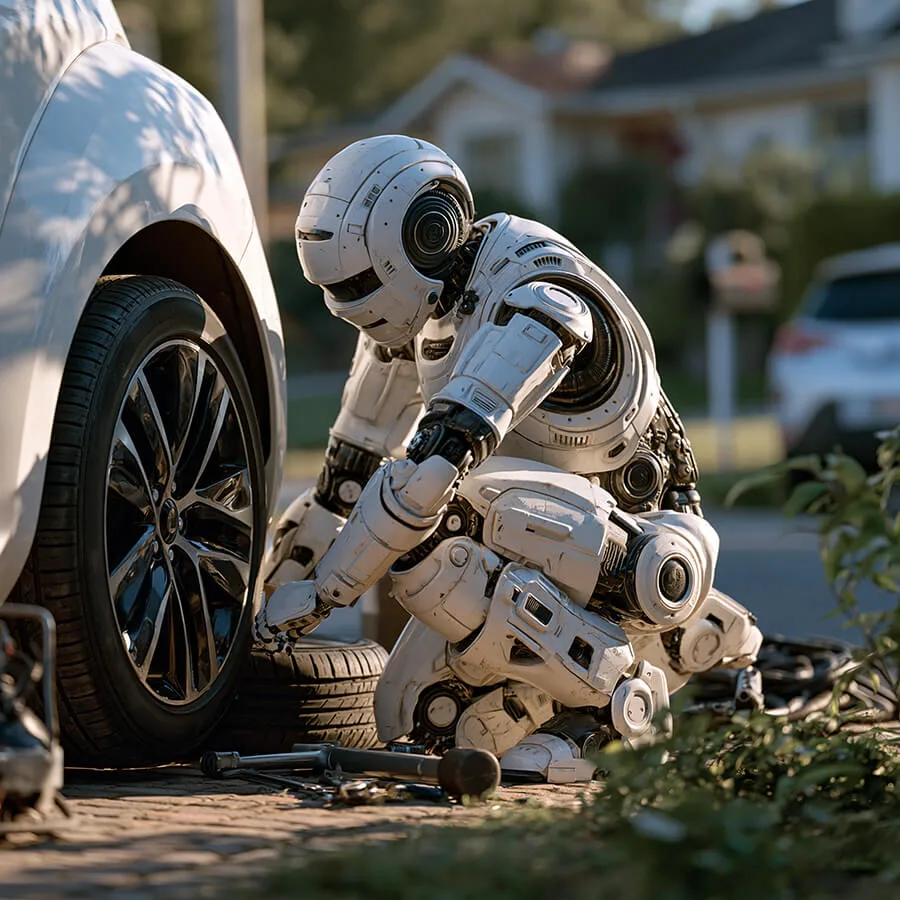
In the household of the future, owning a robot will not represent a static state, but rather a continuously expanding suite of services. Take seasonal car tire changes, for example. Instead of booking an appointment at the garage weeks in advance, we will simply purchase the official tire-change application for our machine. Our robot will walk into the garage, identify the vehicle’s lifting points using its onboard cameras, unscrew the fasteners, and then mount the new tires with millimeter precision and torque corresponding to factory specifications. At the end of the process, the software will automatically send a diagnostic report to our phone regarding the condition of the brake pads. This type of physical flexibility fundamentally rewrites the functioning of the traditional service sector.
The same principle will elevate personalised education to a new level. Consider a situation where our child is struggling with mathematics. Instead of hiring a tutor, we can subscribe to an intuitive, interactive tutoring software. The humanoid will not present the properties of triangles on a flat screen; it will pick up real wooden building blocks. It will build physical models on the kitchen table and, with infinite patience, adjust the pace of its explanation to the student’s level of understanding using cameras that analyse the child’s reactions second by second. Later in the afternoon, if we want to perfect our tennis forehand, the robot will take a racket in hand in the backyard. Guided by a downloaded sports trainer application, it will demonstrate the correct technique through its own movements while analysing the arc and dynamics of our swing in real time.
Microtransactions and the economics of the Gordon Ramsay custom personality pack
The business logic of robotic app stores is vastly different from simple, one-time purchases. Developing and continuously updating this software requires immense resources, which is why providers are introducing hybrid payment models. For rarely used, highly specific tasks, pay-per-use rental will be the most sensible solution. If we want to renovate the parquet flooring in our apartment, buying expensive, professional flooring software is unnecessary. Renting it for forty-eight hours is entirely sufficient. During this time, the machine will precisely cut and lay the planks, and once the license period expires, the software will be deleted from its memory.
In contrast, everyday activities will be linked to continuous subscriptions, downloadable add-ons, and microtransactions. Our robot will be able to wash dishes with the basic package, but if we want it to dry expensive crystal glasses and fine porcelain with special care and without water spots, we will need to purchase the premium kitchen add-on. Personality and style packages will also emerge. Alongside the cooking application, we will be able to download a Gordon Ramsay character pack, allowing the machine to instruct us on ingredient prep with the famous chef’s signature tense cadence and humor. For bedtime storytelling, we can select David Attenborough’s soothing voice and captivating narrative style from the marketplace. The latest tier of monetisation will be physical in-app purchases. If the robot detects during a complex cocktail recipe that it lacks the appropriate shaker, the background software will immediately offer to order a compatible adapter from the internet, arriving at our doorstep the next day.
Environmental benefits and the rebirth of our free time
The brightest vision of this technology promises the complete physical liberation of humanity. The daily two to three hours of housework (washing, cleaning, tidying, and maintenance) will permanently disappear from our daily routines. People will regain control over their time, which they can devote to their families, creativity, or relaxation. Furthermore, robotic applications will democratise highly skilled expertise. An elderly person living in an isolated, small village will have access to the same world-class physical therapist or nursing software through their humanoid as a patient in an elite private clinic. The machine does not tire, does not rush, and is available twenty-four hours a day.
This software-driven flexibility could also give new momentum to sustainability efforts. Today, if a vacuum cleaner or a toaster breaks, it is often cheaper to buy a new one than to take it to a professional. However, a universal home appliance repair application downloaded to our robot will be capable of autonomously diagnosing the fault. The machine will disassemble the device, identify the burnt-out component, solder the damaged circuit, and reassemble the appliance. With the revival of a repair culture, the volume of electronic waste could drastically decrease, while the lifespan of our belongings multiplies. Humanoids will not be consumers, but guardians of our existing assets.
Living room security vulnerabilities and the threat of subscription lockouts
Directing the physical world through software, however, carries unpredictable dangers. Cybersecurity becomes a matter of life and death when hackers can compromise not just our hard drives, but also the hundred-kilogram metal structures walking around our homes. A malicious piece of code could cause the machine to deliberately loosen a car tire during the previously mentioned change, or ignite a fire in the bedroom by tampering with the iron’s software. Security vulnerabilities and poorly tested applications will pose a direct physical threat in our everyday living spaces.
In parallel, tech monopolies could gain a level of control over our lives that was previously unimaginable. If a robot manufacturer decides to place the walking-assist or balancing algorithm behind a monthly subscription fee, our machine will become useless if a payment is missed. Our most basic physical needs will become hostages to software licenses. Finally, we must also reckon with the complete unraveling of our social fabric. If the artificial intelligence-powered conversation programs downloaded to our robot turn the machine into a perfect, conflict-free, always-understanding companion, many may choose to avoid difficult human relationships filled with compromise. A world looms where loneliness is managed with subscription-based, simulated empathy, while our real communities wither away entirely.
Conclusion
The app store for humanoid robots represents a profound reprogramming of our physical reality. Just as mobile applications reshaped communication and information flow, this new software market will transform manual labor, domestic roles, and the economy. The main challenge in the coming years is to manage the physical and economic risks of network-connected steel bodies. The physical App Store will happen, but its success will ultimately depend on how safely and affordably these software packages can run in our homes.
If you ask me where I stand on this conundrum, I lean toward cautious optimism. Outsourcing the soul-crushing monotony of domestic labor, the scrubbing, the folding, the endless maintenance: that is a net positive that humanity has earned after centuries of manual toil. Yet, the thought of a tech monopoly holding a remote kill-switch over my household functions, or a flawed update turning a hundred-kilogram appliance into a hazard, is genuinely unsettling. We are effectively inviting operating systems into our physical living rooms, and history shows that software rarely ships without bugs.
Would you be willing to hand over the keys to your home to a third-party developer for an extra two hours of free time every evening, or does the idea of an app store running your household feel like one download too far?