



Introduction
For most businesses, AI adoption has outpaced AI governance. That gap is going to catch a lot of leadership teams off guard.
Since Generative AI properly arrived in late 2022, adoption has moved fast. Most businesses rightly gave their teams the freedom to experiment first and worry about process later. Developers picked up AI coding assistants because they made them faster. Teams started plugging AI into pipelines because it worked. Almost none of this happened with a plan attached. It happened because it was useful, experimentation was encouraged, and nobody wanted to be the one slowing things down.
The problem is, moving fast and staying in control rarely happen at the same time, and that gap is where AI governance comes in. It is simply the framework of policies, controls, and oversight that makes sure AI is used responsibly, securely, and in line with what your business and your regulators actually require. It is not about slowing adoption down. It is about knowing what is happening inside your own software delivery process before you find out the hard way.
Why this is not optional anymore
Here is the pattern I keep seeing: businesses adopt AI tools quickly, get real value from them, and quietly assume that because nothing has gone wrong yet, nothing will. That assumption may not hold for long.
Every AI assistant your developers use is another system that can see inside your business, whether it was ever formally approved or not. AI-generated code carries its own patterns of vulnerability, different to what your existing security tooling was built to catch. And regulation is starting to catch up with this space directly, with standards like ISO 42001 and the EU AI Act starting to expect businesses to prove they know what their AI is doing, not just that it is doing something useful.
None of this is hypothetical, and it is not a new pattern either. Cloud adoption went through the same phase a decade ago: businesses moved fast because the benefits were obvious, then spent years retrofitting the security, cost control, and oversight that should have been there from the start. AI is following the same curve, just compressed into a much shorter timeframe. The businesses that get ahead of it now will have a far easier time than those who wait for an incident to force the conversation.
What you actually need to be tracking, and why
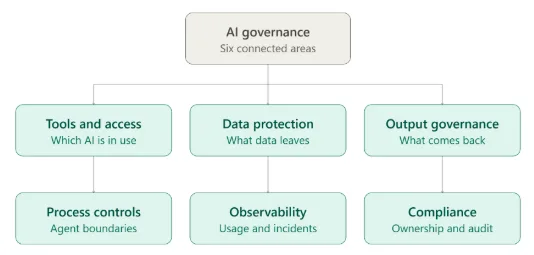
Once you accept that AI governance matters, the next question is what it actually covers. It breaks down into six connected areas, and it is worth understanding them as a system rather than a checklist.
Tools and access comes first. Do you know which AI assistants, models, and increasingly autonomous agents are actually being used across your business? Not which ones were approved, but which ones are actually in use. Shadow AI, tools adopted informally by individual developers or teams, is far more common than most leadership teams realise.
Data protection is next, and it is the area most industries are treating as the highest priority right now. Every prompt sent to an AI tool is an opportunity for proprietary code, credentials, or personal data to leave your control. This needs the same discipline you would apply to any other sensitive data flow.
Output governance covers what comes back the other way. Can you tell which code was written by a person and which was written by AI? AI-generated code tends to fail differently to human-written code: it can introduce insecure defaults, reference dependencies that sound plausible but do not actually exist, or look correct enough to pass a quick review while quietly containing a flaw. Standard scanning and review processes were not built with these patterns in mind, and yours may need to catch up. And are you confident the output is not quietly reproducing someone else’s licensed work?
Process and workflow controls determine where a human needs to be in the loop, and where an AI agent’s autonomy needs a hard boundary instead. Do you know which actions require sign-off before they happen, rather than relying on someone remembering the policy in the moment? Examples of this include what an agent can access, what commands it can run, and whether it can open a pull request or push straight to production.
Observability and monitoring is about visibility over time: usage, cost, defect rates on AI-generated code, and a full audit trail of what any autonomous agent has actually done. Can you currently measure the impact, positive or negative, that AI is currently having on your business?
Finally, compliance and accountability ties it together. Every AI-assisted change needs a clear human owner, and you need to be able to reconstruct how a piece of code came to exist, prompts and approvals included. If an auditor asked you to evidence how a piece of code came to exist, prompts and approvals included, could you produce that today?
So how do you actually solve this?
The honest answer is that the market is not settled (every day something new is announced and there are new ways of using AI), and so there is no single tool that covers all six areas well. What exists today generally falls into two camps.
The first is familiar security and code quality tooling that has extended itself to cover AI. These are established platforms your teams may already use, now adding features to label AI-generated code, apply stricter checks to it, and flag AI-specific vulnerability patterns.
The second is a newer category built specifically for AI governance from the ground up. These tools focus on things older platforms were never designed for: discovering shadow AI usage, intercepting risky prompts before they reach a model, and governing what autonomous agents are allowed to do inside your pipelines.
In practice, most businesses will end up stitching together a combination of both, rather than finding one solution that fits everything. A small team might get most of the way there with free or low-cost tools and some manual configuration. A larger, regulated business is more likely to need a dedicated governance platform sitting across the whole software delivery lifecycle, backed by the security tooling it already trusts.
Should you wait until this feels more urgent?
No. But you also do not need to solve all six areas on day one.
Start by asking two honest questions. First, do you actually know what AI tools are in use across your business right now, officially or otherwise? If you cannot answer that with confidence, that is your starting point, not the fancier problems further down the list. Second, out of the six areas above, which one would cause the most damage if it went wrong tomorrow? For most businesses right now, that is data protection. For others, particularly in regulated industries, it may be compliance and audit.
Pick that one area, put a basic control in place, and build outward from there. AI governance is not a project with an end date. It is an ongoing practice that needs to grow alongside how deeply AI is embedded in the way you build software. The businesses that treat it that way, starting small and expanding deliberately, will be in a far stronger position than the ones hoping the gap between adoption and oversight closes itself.
It will not close on its own. But it is a very solvable problem, and there has never been a better time to start.